Yes. Brilliant can help teachers serve students at different readiness levels in the same class or school. Brilliant's strongest differentiation levers are content and pace: one student can revisit a prerequisite, another can practice the current objective, and another can move into a more challenging topic. Teachers can still choose the starting point, connect Brilliant to class goals, and use their own assessments or discussions to confirm understanding.
Can Brilliant support differentiated instruction?
Yes, especially when the goal is to vary what students work on or how quickly they move.
Differentiation usually means adjusting instruction based on a student's readiness, interests, or learning profile. In practice, that often happens through three levers: content, process, and product. A tool can be strong on one lever and lighter on another. Today, Brilliant's strongest differentiation fit is content and process.
| Differentiation lever | Where Brilliant fits | What that looks like in class |
|---|---|---|
| Content differentiation | Strong fit | Students can work on different topics, prerequisites, or challenge courses. |
| Process differentiation | Strong fit | Lessons are self-paced, and practice gives students feedback, hints, and explanations while they work. |
| Product differentiation | Moderate fit | Students show progress by completing interactive lessons, associated skill checks, and level reviews. Teachers may still want separate checks, discussions, or assessments when they seek deeper explanation or a formal grade. |
How Brilliant supports mixed-readiness classrooms
Brilliant solves the problem of students in the same room needing different levels of math at the same time. Prerequisite review, current-topic practice, and enrichment can happen in parallel without the teacher building three separate activities from scratch.
For example, in a sixth-grade ratios and proportions unit:
- A student missing a prerequisite might revisit Fractions, Percents, or earlier Proportional Reasoning lessons such as Setting Up Ratios, Scaling Up Recipes, or Computing Unit Rates before returning to the class objective.
- A student on pace with the class might work in Proportional Reasoning, including lessons on unit rates, graphing proportional relationships, or writing equations.
- A student ready for more challenge might extend into Probability and Chance, Logic, Number Theory, or another connected enrichment topic.
The same pattern can work in algebra, geometry, statistics, calculus, or computer science: one student gets a prerequisite or review, one student practices the current objective, and one student moves into a deeper or adjacent challenge.
Classroom differentiation can fail when the different paths students need also require separate, customized teacher-built lesson plans. Brilliant gives teachers a searchable catalog of lessons, courses, topics, and standards, so they can choose a better starting point without creating every activity from scratch.
What adapts inside Brilliant
Some differentiation happens inside Brilliant, most clearly through practice that responds to what a learner has already worked on.
- Practice can respond to learning history. Each lesson ends with a Skills Check. If a learner doesn't ace the skills check, they get another opportunity with new practice problems to try again. Brilliant's practice system uses what a learner has made mistakes on and responds with useful next problems.
- Feedback helps students adjust while they work. When a student answers incorrectly, Brilliant shows real-time feedback (like "try again!") and step-by-step explanations, instead of only marking the answer wrong.
- Skill checks and level reviews help students respond to performance. These give students a way to check understanding across a lesson or level and review mistakes before moving on.
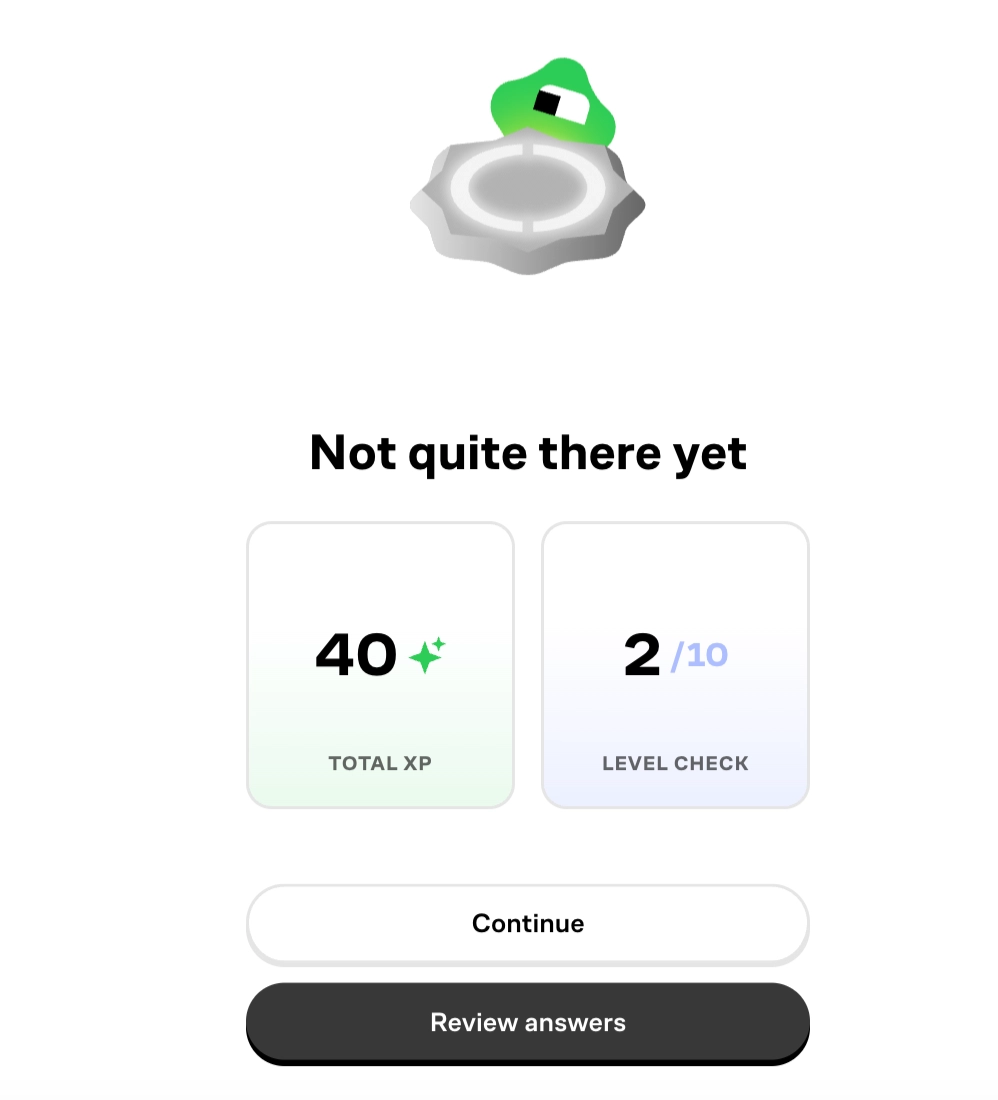
- Students can also choose different paths. A teacher can assign specific lessons to individual students, and students can also revisit earlier material, keep going in a course, or explore another topic when they are ready. They do not all need to move through the same material at the same speed.
These adaptations make Brilliant useful for independent practice, rotations, early-finishers, enrichment blocks, and small-group support. A teacher does not need every student to be on the same screen at the same time for the class period to work.
What the teacher still decides
We do not remove the teacher's role in differentiation. You can still decide:
- which objective matters today;
- which students should work on the current lesson, an earlier prerequisite, or an extension;
- when a student needs discussion, direct instruction, or a different representation;
- how to check whether the student can explain or transfer the idea; and
- when Brilliant should be paired with a formal intervention plan, assessment, or accommodation.
This is especially important for students who are below grade level. Brilliant can provide a lower-stigma way to revisit an earlier concept, but choosing the right prerequisite and following up on student understanding remains a teacher-driven decision.
Is Brilliant better for advanced students or students who need support?
Brilliant can support both, but the use case is different.
For advanced students, the range of content does the most work. A student can keep moving into harder or more interesting material without waiting for the rest of the class to finish.
For students who need support, Brilliant works best when the teacher identifies the missing prerequisite, assigns a focused lesson, and follows up with instruction or discussion.
Frequently asked questions
Can two students in the same class work on completely different material at the same time?
Yes. Lessons are self-paced, and teachers can assign different courses or lessons to specific students in the same class. This is useful for rotations, early-finishers, enrichment blocks, or targeted support.
Does Brilliant automatically change or choose the right lesson for each student?
Not in the way a formal diagnostic or placement system would. Brilliant can adapt practice within a lesson, but teachers should still choose the starting point based on the class objective and what each student needs.
Can Brilliant support gifted or advanced students?
Yes. Brilliant's catalog includes advanced and enrichment topics such as contest math, logic, number theory, statistics, calculus, and computer science. Advanced students can keep exploring without requiring the teacher to build a separate extension activity.
Can Brilliant replace an intervention program?
No. Brilliant can support targeted practice, but it is not a full intervention program. Schools should still use diagnostic assessment, progress monitoring, individualized goals, and teacher- or specialist-led support when those are needed.